
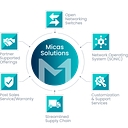
Micas Networks hasn't been mentioned in our coverage yet.
Who is Micas Networks?
Micas Networks is a networking equipment provider focused on open, carrier-grade routing platforms for service providers and large-scale enterprises.
- Open and disaggregated routing systems for carrier and cloud networks (network infrastructure)
- Support for scale-out architectures for backbone, metro, and Data Center Interconnect (DCI) environments
- Integration of industry-standard network operating systems and open networking ecosystems
- Hardware platforms designed for high-throughput IP/MPLS and Ethernet transport
- Solutions targeted at telecom operators, cloud providers, and large enterprise network operators
Show more
More About Micas Networks
Micas Networks focuses on open and disaggregated routing platforms used by telecom operators, cloud providers, and large enterprises that require scalable IP and Ethernet transport. Its systems are positioned for core, aggregation, and edge environments, including backbone networks, metro aggregation, and DCI. The company centers its offering on carrier-grade hardware that interoperates with widely adopted network operating systems and open networking toolchains, which allows operators to align infrastructure with their own software and automation strategies.
The platforms from Micas Networks support architectures based on standard routing and switching protocols, such as Border Gateway Protocol (BGP), Open Shortest Path First (OSPF), IS-IS, Multiprotocol Label Switching (MPLS), Segment Routing, and Ethernet Virtual Private Network (VPN), depending on the network Operating System (OS) chosen by the customer. By aligning with open networking ecosystems, Micas Networks equipment is typically integrated into environments that use standardized APIs, model-driven configuration (for example NETCONF/YANG), and common telemetry frameworks. This approach allows network engineering teams to fold Micas-based infrastructure into existing Software Defined Networking (SDN) controllers, orchestration systems, and Continuous Integration and Continuous Deployment (CI/CD) pipelines used for network automation.
In the service provider space, Micas Networks targets roles such as IP core and aggregation routers, provider edge, and high-density Ethernet transport, where deterministic throughput, port density, and interoperability with multi-vendor networks are primary requirements. In cloud and large enterprise environments, its platforms are positioned for Wide Area Network (WAN) edge, DCI, and campus or regional aggregation, particularly where organizations standardize on open network operating systems and want flexibility in software sourcing while retaining consistent hardware capabilities.
From a marketplace taxonomy perspective, Micas Networks fits into the categories of IP networking hardware, carrier routing (network infrastructure), and open networking platforms. Its solutions are typically evaluated alongside other vendors in the open and disaggregated networking domain, where the separation of hardware and software is an architectural requirement. Enterprise architects and network planners consider Micas Networks equipment as building blocks for scalable, multi-vendor architectures that support Traffic Engineering (TE), multi-tenant VPN services, and high-bandwidth interconnects across distributed sites.
Because the company emphasizes open ecosystems, its offerings align with frameworks that rely on standardized interfaces, hardware abstraction, and support for third-party or community network operating systems. This aligns with procurement and design strategies in carriers and large enterprises that aim to decouple hardware lifecycle from software roadmap decisions, while maintaining conformance with established routing, MPLS, and Ethernet transport standards.