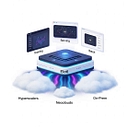
Managed Kubernetes Service (MKS)
1 organization in our directory is tagged Managed Kubernetes Service.
What is Managed Kubernetes Service?
A Managed Kubernetes Service (MKS) is a cloud or platform service in which a provider deploys, operates, and maintains Kubernetes Control Plane (KCP) components and cluster lifecycle tasks while the customer focuses on containerized applications and worker-node configuration.
Show more
Expanded Explanation
1. Technical Function and Core Characteristics
A MKS hosts the KCP, including Application Programming Interface (API) server, scheduler, controller manager, and etcd, as a provider-operated service with defined service-level characteristics. The provider automates cluster creation, upgrade, scaling, and repair workflows through APIs, consoles, and integrations. It typically supplies default configurations and policies for networking, storage classes, logging, and monitoring, while allowing customers to configure namespaces, workloads, and access controls.
These services commonly include automated version management for Kubernetes releases, patching of control-plane components, and integration with provider identity and access management systems. They may also expose cluster metrics, audit logs, and security settings that align with provider or industry recommendations for multi-tenant or shared-responsibility environments.
2. Enterprise Usage and Architectural Context
Enterprises use managed Kubernetes services as the orchestration layer for container-based applications, microservices, and cloud-native workloads in public cloud, hybrid cloud, and sometimes edge architectures. The service functions as an abstraction over infrastructure, enabling teams to schedule and manage containers without operating the full Kubernetes stack.
In enterprise architectures, managed Kubernetes often underpins platform engineering, internal developer platforms, and Continuous Integration and Continuous Deployment (CI/CD) pipelines. Security and networking teams integrate the service with existing identity providers, network segments, service meshes, and policy engines, while operations teams align it with backup, Disaster Recovery (DR), and observability platforms.
3. Related or Adjacent Technologies
Managed Kubernetes services relate to container runtimes, container registries, and service meshes that run on or integrate with Kubernetes clusters. They intersect with infrastructure as a service, where virtual machines and networks host worker nodes, and with platform as a service offerings that build on Kubernetes primitives.
They also connect to policy and configuration management tools, such as GitOps platforms, infrastructure as code frameworks, and admission control systems. Other adjacent technologies include workload identity, secrets management, cloud storage, and load balancing services that provide persistent storage and ingress for Kubernetes workloads.
4. Business and Operational Significance
For enterprises, a MKS reallocates operational responsibility for control-plane availability, upgrades, and security hardening to a provider under a documented Shared Responsibility Model (SRM). This approach reduces the internal requirement to staff specialists for core Kubernetes operations and lifecycle management.
It allows organizations to standardize on Kubernetes as a deployment and orchestration substrate across teams and environments while aligning with governance, compliance, and cost-management processes. The model supports consolidation of observability, access control, and policy across multiple clusters maintained through a provider-managed control-plane layer.
Our definition.