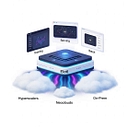
Managed HPC Environment
What is Managed HPC Environment?
A managed High performance computing (HPC) environment is a HPC infrastructure that a third-party provider or centralized IT organization provisions, operates, secures, and supports as a managed service for compute- and data-intensive workloads.
Expanded Explanation
1. Technical Function and Core Characteristics
A managed HPC environment delivers clustered compute, high-speed interconnects, and parallel file systems configured and administered by a specialized operations team. It typically includes workload managers, resource schedulers, monitoring, security controls, and user support services. Providers implement standardized images, software stacks, and automation for provisioning, patching, performance tuning, and incident response across on-premises (on-prem), cloud, or hybrid deployments.
Show more
Such environments support parallel and distributed applications that use message passing, shared memory, or accelerator programming models. They enforce policies for job queuing, resource allocation, quota management, and Data Lifecycle Management (DLM) through centralized orchestration and configuration management tools.
2. Enterprise Usage and Architectural Context
Enterprises use managed HPC environments to run simulations, analytics, and modeling workloads for domains such as engineering, life sciences, finance, and energy. Central IT or an external provider integrates the environment with identity and access management, storage platforms, and network security controls. Architectures often combine on-prem clusters or supercomputers with cloud-based HPC resources through hybrid or burst models under a unified management and governance framework.
Organizations align managed HPC environments with policies for data classification, compliance, and audit, including controls for encryption, logging, and change management. They also integrate with enterprise service catalogs, cost allocation mechanisms, and project-based access controls to support multiple business units and research groups.
3. Related or Adjacent Technologies
Related constructs include traditional on-prem HPC clusters operated entirely by in-house teams, cloud-native HPC services, and managed Kubernetes or container platforms used for compute-intensive workloads. Managed HPC environments may interoperate with high-throughput computing systems, big data platforms, and Artificial Intelligence (AI) or Machine Learning (ML) infrastructure that use Graphics Processing Unit (GPU) or accelerator-based nodes.
They also align with configuration and orchestration technologies such as infrastructure as code, container orchestration, and workflow management tools used for scientific computing. Integration with parallel file systems, object storage, and data management frameworks supports movement and retention of large research and simulation datasets.
4. Business and Operational Significance
For enterprises, a managed HPC environment provides predictable governance, security, and operational oversight for compute-intensive workloads without requiring every business unit to run its own cluster operations. Centralized management can support capacity planning, utilization reporting, and policy enforcement across heterogeneous infrastructure. Organizations can align service levels, availability targets, and support processes with broader IT service management practices.
This approach allows enterprises to treat HPC as a shared, cataloged service with defined cost models and access procedures. It also enables alignment with regulatory, data protection, and risk management requirements through standardized controls, auditability, and documented operational processes.
Our definition.